




Fibre-Coupled GaSb Quantum Dot Tuneable Single-Photon Sources for Field Deployed Quantum Key Distribution
FiGAnti
ABOUT
The security of data transmission in classical cryptography is based on the mathematical complexity required to hack passwords and cryptographic keys. An alternative method of encryption is quantum cryptography. In this case, security is ensured by the fundamental laws of physics governing the microscopic world, as described by quantum mechanics. For instance, it is not possible to copy an unknown physical state (one can only make another object assume this state via quantum teleportation, but in doing so, the state of the original object is modified), and every measurement influences the state of the measured object—leaving a detectable “fingerprint.” It is also important that matter and energy are quantized, meaning they exist in minimal, indivisible units called quanta.
Such a quantum of electromagnetic radiation is called a photon. Single photons can be used to encrypt cryptographic keys. To achieve this, efficient single-photon sources are required. These sources should have a low probability of multiphoton emission and a high generation rate of single photons. For practical application, the source should emit photons with wavelengths in the third telecommunication window, around 1550 nm, which corresponds to minimum loss in commonly used silica fibers. This ensures the longest possible distance for data transmission. Additionally, single-photon sources should be compact and fiber-coupled to ensure compatibility with existing fiber infrastructure.
The most promising physical system for generating single photons is epitaxial quantum dots. They offer outstanding quality of emitted single photons and the ability to achieve high generation rates with low probability of multiphoton events, along with compatibility with semiconductor technology. Quantum dots emitting in the visible and near-infrared spectral ranges have reached a level of technological maturity that allows for nearly ideal single-photon sources. However, despite 20 years of research, it has not yet been possible to transfer these achievements to quantum dots emitting in the telecommunication spectral range.
Within the ‘Fibre-Coupled GaSb Quantum Dot Tuneable Single-Photon Sources for Field Deployed Quantum Key Distribution’ (FiGAnti) project we propose an alternative material system, not yet explored in this regard, namely (In)GaSb/AlGaSb quantum dots. Within the project, we are optimizing their growth and explore device fabrication to achieve efficient emission in the telecom spectral range. Furthermore, we are developing a description of their electronic structure and measure and quantify their optical properties.
Main benefits of the GaSb-based system:
- Emission at 1.55 µm
- High refractive index and index contrast at 1.55 µm
- Direct growth on Si for scalable integration
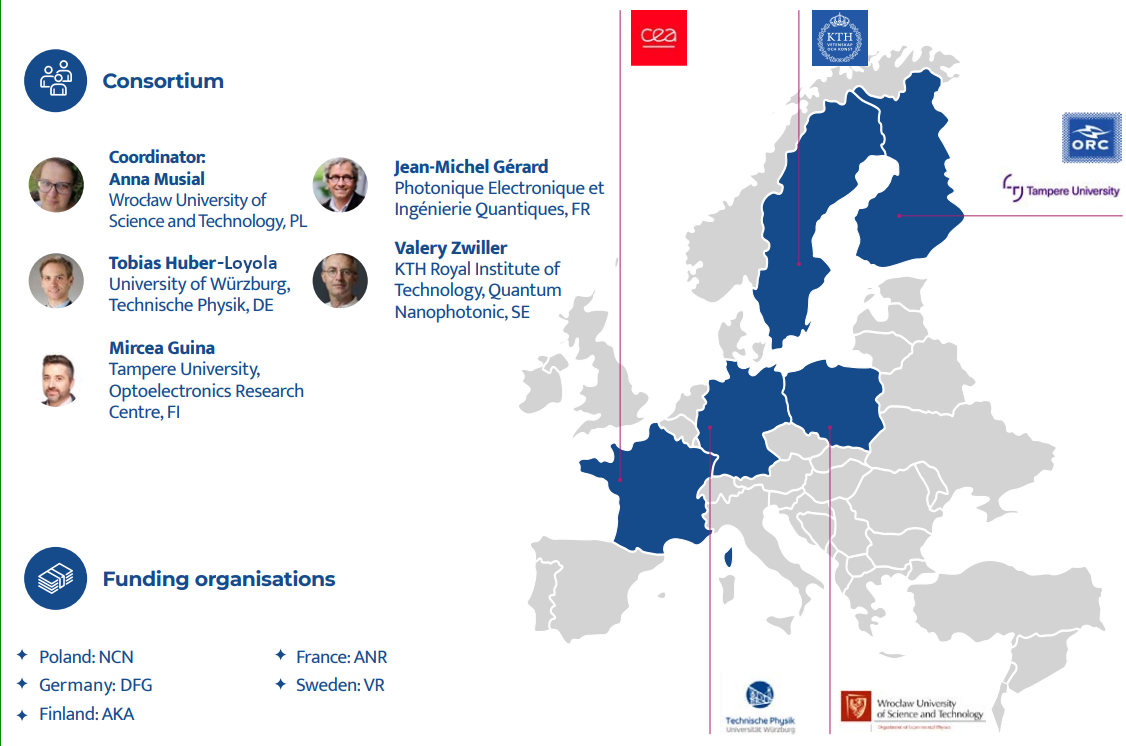
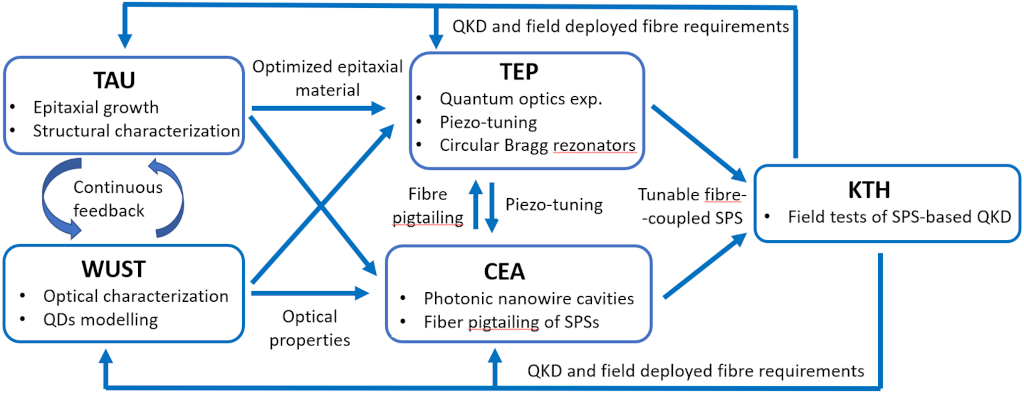
Partner responsible for epitaxial growth of structures with quantum dots is University of Tampere (Finland) and the feedback about quality of investigated structures will be provided by Wrocław University of Science and Technology (Poland). Optimised structures will be hand over to partners from Germany (University of Würzburg) and France (The French Alternative Energies and Atomic Energy Commission in Grenoble), who will design and fabricate optical cavities, enabling higher generation rates of single photons. Additional functionalities of developed single-photon sources will be stabilisation of emission, possibility to tune emission wavelength and robust connection to the fibre. The most promising sources will be used for implementation of BB84 quantum key distribution protocol. It will not be a proof-of-principle demonstration but using existing deployed fibre link between KTH Royal Institute of Technology in Stockholm and Ericsson Labs 17 km away. This allows verification of application potential of developed source of single photons.
Project objectives – (In)GaSb/AlGaSb QDs:
- Optimise epitaxial nanohole droplet etching growth: emission in the 3rd telecom window, QD density < 108 /cm2, inhomogeneous broadening of QDs < 10 meV;
- Determine electronic structure and fundamental optical properties;
- Explore nanowire cavity designs: Purcell factor (FP) ~10, outcoupling efficiency > 50%;
- Explore circular Bragg grating cavity designs: FP > 10, outcoupling efficiency > 80%;
- Develop strain tuning of Antimony-based QDs: tuning range of 5 nm;
- Develop compact fibre-coupled SPS with coupling efficiency into the single-mode (SM) fibre on the level of 25% into 0.4 numerical aperture (NA);
- Implement field deployed SPS-based QKD and benchmark it against commercial state-of-the-art decoy state and discrete/continuous variable systems.
Project FiGAnti is funded within the QuantERA II Programme that has received funding from the European Union’s Horizon 2020 research and innovation programme under Grant Agreement No 101017733.





DISSEMINATION
M. Gaignard, M. Finazzer, C. Spinnler, G. N. Nguyen, S. Kotal, A. Artioli, Y. Genuist, N. Gregersen, J.-P. Poizat, J.-M. Gérard, R. J. Warburton, J. Claudon, Resonance Fluorescence from a Single Quantum Dot in a Nanopost Optical Cavity, ACS Photonics 12(7), 3671 (2025)
Resonance Fluorescence from a Single Quantum Dot in a Nanopost Optical Cavity | ACS Photonics
T. Hakkarainen, J. Hilska, A. Hietalahti, S. Ranta, M. Peil, R. Matysiak, E. Kantola, A. Chellu, E. Sen, J.-P. Penttinen, A. Musiał, M. Gawełczyk, M. Guina, Telecom wavelength single-photon emission from quasi-resonantly excited InGaSb/AlGaSb quantum dots, arXiv:2404.06083v2 [cond-mat.mes-hall]
Telecom wavelength single-photon emission from quasi-resonantly excited InGaSb/AlGaSb quantum dots
M. A. Jacobsen, Y. Wang, L. Vannucci, J. Claudon, J.-M. Gérard, and N. Gregersen, Performance of the nanopost single-photon source: beyond the single-mode model, Nanoscale 15, (2023)
Performance of the nanopost single-photon source: beyond the single-mode model
J. Michl, G. Peniakov, A. Pfenning, J. Hilska, A. Chellu, A. Bader, M. Guina, S. Höfling, T. Hakkarainen, T. Huber-Loyola, Strain-Free GaSb Quantum Dots as Single-Photon Sources in the Telecom S-Band, Adv. Quantum Tech. 6, 2300180 (2023)
Strain-Free GaSb Quantum Dots as Single-Photon Sources in the Telecom S-Band
A. Chellu, J. Hilska, J.-P. Penttinen, and T. Hakkarainen, Highly uniform GaSb quantum dots with indirect–direct bandgap crossover at telecom range, APL Mater. 9, 051116 (2021)
Highly uniform GaSb quantum dots with indirect–direct bandgap crossover at telecom range
J. Hilska, A. Chellu, and T. Hakkarainen, Nanohole Etching in AlGaSb with Gallium Droplets, Crystal Growth & Design, 21, 1917 (2021)
Nanohole Etching in AlGaSb with Gallium Droplets | Crystal Growth & Design
CONTACT
Wrocław University of Science and Technology
Laboratory for Optical Spectroscopy of Nanostructures
Department of Experimental Physics
Faculty of Fundamental Problems of Technology
Wybrzeże Wyspiańskiego 27
50-370 Wrocław, Poland
Dr. Anna Musiał
Project coordinator